
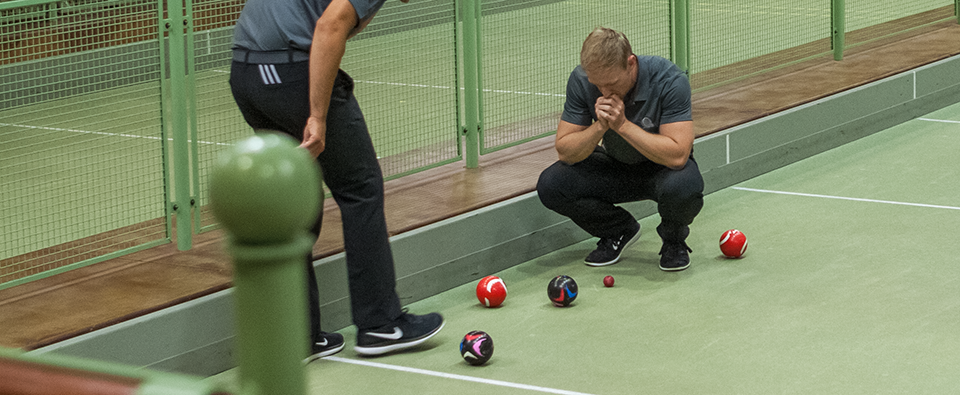
Bocce courts at Palazzo di Bocce

Indoor • Social • Competitive

Play Bocce!

Reserve indoor bocce courts, join leagues, learn the rules, follow schedules, and enjoy year-round bocce at Palazzo di Bocce.

Why Bocce

Bocce is easy to learn, social, and built around fun, strategy, and good sportsmanship. Because Palazzo courts are indoors, bocce can be played year-round.

New guests can learn quickly, while experienced players can enjoy the game’s strategy and competitive challenge.

Why Guests Enjoy Bocce

  • Stress relief
  • Improves coordination
  • Sharpens your mind
  • Some light cardio
  • Improves flexibility

Reservations

Court reservations are available up to one week in advance and are highly recommended.

Call 248-371-9987 option 1 for court reservations or reservation questions.

Each court accommodates a maximum of 12 people per time slot.

An additional fee may apply when requesting multiple lanes for groups of 10 or fewer.

Groups larger than 12 people, or reservations further than one week away, should review the Events page and contact the events department at option 2.

Court Rental Duration

80 minutes of play are included for $13 per person, with up to 10 additional minutes for instruction, payment, and departure for the next reservation.

Guests are asked to be mindful of their end time so the next reservation can begin with a clean and ready court.

Bocce leagues icon

Get in the Game!

Whether guests are just learning or already experienced players, Palazzo bocce leagues are built for fun, comfort, and competition.

League formats support casual players looking for fun and competitive players interested in higher-level play.

Team Palazzo has placed second in world bocce tournaments and has won more than 75% of United States bocce competitions entered.

League players can learn from experienced players and may have opportunities to pursue higher-level competition if they reach the necessary skill level.


Bocce league fun at Palazzo di Bocce
ABC Bocce welcome ABC tournament logo

The ABC United States Open Bocce Championships

Gather family, friends, and bocce fans for one of Palazzo’s biggest bocce events of the year.

Every September

View ABC Bocce

Bocce Videos

New to bocce or looking to improve? View bocce videos for rules, lessons, strategy, and fun for all ages.

View Bocce Videos

Bocce rules

Bocce Rules

Download the abbreviated rule book or review the basic rules below.

Read the Rules

Bocce Teams

Bocce Teams

Teams are composed of four players. Two players from each team are stationed at each end of the court, throwing two bocce balls each.

At the end of each frame, play resumes at the opposite end of the court.

Begin the match with the flip of a coin between the captains. The winner may toss the pallino first or choose the color of the bocce balls.

Tossing the Pallino

Tossing the Pallino

The pallino is legal if it passes the center line, is at least 3 feet off the back board, and at least 1 foot from the side wall.

If a player fails to toss the pallino properly, the opposing team tosses it. If that team also fails, the pallino reverts back to the original team.

Any time a player is rolling, opposing players must remain outside the court.

Starting the Bocce Game

The first ball is thrown by the team that originally tossed the pallino. If that bocce ball hits the back board, the ball is removed and the team must roll again until it has a ball in play.

The other team throws until it beats, not ties, the opposing ball. This continues until both teams have used all their balls.

Whenever a team gets a ball closer, it steps aside and lets the other team roll.

Bocce Balls That Hit the Back Board

Bocce Balls That Hit the Back Board

A ball hitting the back board without hitting another ball first is dead and must be removed from play.

If the thrown ball hits another ball and then the back board, all bocce balls are valid.

If a thrown ball hits the back board and then strikes a stationary ball without first touching another ball, the stationary ball is replaced and the thrown ball is removed.

Balls Leaving the Court

If a bocce ball leaves the court, hits the fencing, and falls back into the court, it is dead and should be removed from play.

If the pallino leaves the court, hits the fencing, or rolls back past half-court, the frame is restarted.

Foul Lines

Players may step on, but not over, the foul line before releasing the pallino or their bocce ball.

Bocce Scoring

Only one team scores in a frame. One point is given for each ball that is closer to the pallino than the closest bocce ball of the opposing team.

If the closest balls are equal distance from the pallino, the ball that was thrown first gets the point.

Games are normally played to 12 or 15 points. The tournament host may change this number.

Pallino That Hits the Back Board

Pallino That Hits the Back Board

Once the pallino is in play, it remains in play even if it hits the back board during the game.

If the pallino is knocked out of the court or knocked in front of the center line, the frame ends and play resumes from the opposite end of the court.

Measuring & Disputes

Team captains may measure bocce balls at any time. All disputes are resolved by the tournament host.

Late Arrivals & Substitutions

A team not showing within ten minutes of the scheduled start time loses two points, plus two additional points for each five-minute increment thereafter.

A team not showing within thirty minutes forfeits the game.

A team missing players at the start may play, but each player may only roll two bocce balls. A player arriving late may enter only after completion of the game.

A team may make one substitution per game, and substitutions may only be made between frames.

Bocce Glossary

Bocce
The name of the game and the name of the ball teams try to get close to the pallino.
Pallino
The small target ball, sometimes called the jack.
Punta
A point shot where a player rolls bocce to get close to the pallino.
Raffa
Also known as a spock or hit; a hard throw intended to knock a bocce or pallino out of position.
Volo
An international-rules shot where the player attempts to hit the target ball without contacting the ground first.
Open Rules
A common game version where the main disallowed shot is a bocce touching the back wall without touching another ball first.
International Rules
A stricter form of bocce used in national and world championships.
Rule of Advantage
When an illegal play is called, the opposing team may leave the ball as it lies or restore positions.
Brass Balls
A bocce variation using hollow brass balls.
CBI
Confederatione de Bocce Internacional, a major worldwide bocce governing body.
USBF
United States Bocce Federation, a major U.S. bocce governing body.

Court Dimensions

Bocce court dimensions

History of Bocce

Remember, you do not have to be Italian to play bocce.

Bocce history

The Beginnings of the Sport

Throwing an object toward a target is considered one of the oldest forms of organized play. The objective — coming as close as possible to a fixed target — remains central to bocce.

Bocce developed from ancient throwing games through Greece and Rome. The game’s name is linked to the Vulgate Latin bottia, meaning “boss.”

European Growth

European history includes many references to bocce. Its athleticism and spirit of competition helped the game spread among nobility and common players alike.

The sport was sometimes restricted because of concerns that it interfered with military exercises or was connected with gambling, but it continued to grow across Europe.

Bocce Comes to America

Bocce came to America through European influence and grew substantially with Italian immigrants. Today the game is played under several rule sets throughout the United States.
Da Vinci Bocce logo

Bocce Equipment

Da Vinci Bocce Professional Bocce Products

Our official supplier for bocce gear.

Contact Da Vinci Bocce directly at 248-505-4744 for equipment-related questions.

Da Vinci Bocce